


Introduction
The cost to develop a RateHawk clone usually ranges between $60,000 and $320,000+, depending on the hotel booking features, supplier integrations, agent dashboard, markup engine, wallet system, credit limit, hotel mapping, cancellation flow, admin panel, reporting system, and customization level. A basic RateHawk-like B2B hotel booking platform with agent login, hotel search, booking, vouchers, and admin controls can be developed at a lower cost, while a full-scale B2B travel platform with hotels, flights, transfers, car rentals, multiple APIs, agent hierarchy, white-label portals, credit management, and advanced analytics requires a higher budget.
RateHawk is a B2B travel booking platform used by travel agents, tour operators, OTAs, corporate travel companies, and travel professionals. It allows agents to book hotels, flights, transfers, car rentals, and other travel services through one professional platform.
That is why many travel businesses want to develop a RateHawk clone.
A RateHawk clone is not a direct copy of RateHawk. It is a custom-built B2B travel booking platform inspired by RateHawk’s business model, agent booking flow, hotel distribution system, travel service aggregation, markup control, and professional travel agent dashboard. The platform can be developed for hotel wholesalers, travel consolidators, DMCs, OTAs, B2B travel agencies, corporate travel providers, and travel technology companies.
For businesses that want to sell travel inventory to agents, developing a RateHawk-like platform can create a scalable digital distribution channel. Instead of managing hotel quotes, vouchers, cancellations, payments, and agent requests manually, the platform allows agents to search, compare, book, pay, cancel, and manage bookings from one dashboard.
In this guide, we will explain how to develop a RateHawk clone, including its features, cost, APIs, tech stack, business model, monetization options, development process, timeline, and the major factors that affect the final B2B travel booking platform development cost.
What Is a RateHawk Clone?
A RateHawk clone is a B2B travel booking platform that allows travel agents and partners to book hotels, flights, transfers, car rentals, and other travel services for their customers.
The platform mainly focuses on professional travel sellers. It gives agents access to inventory, rates, availability, booking confirmation, cancellation policies, vouchers, invoices, and reporting tools.
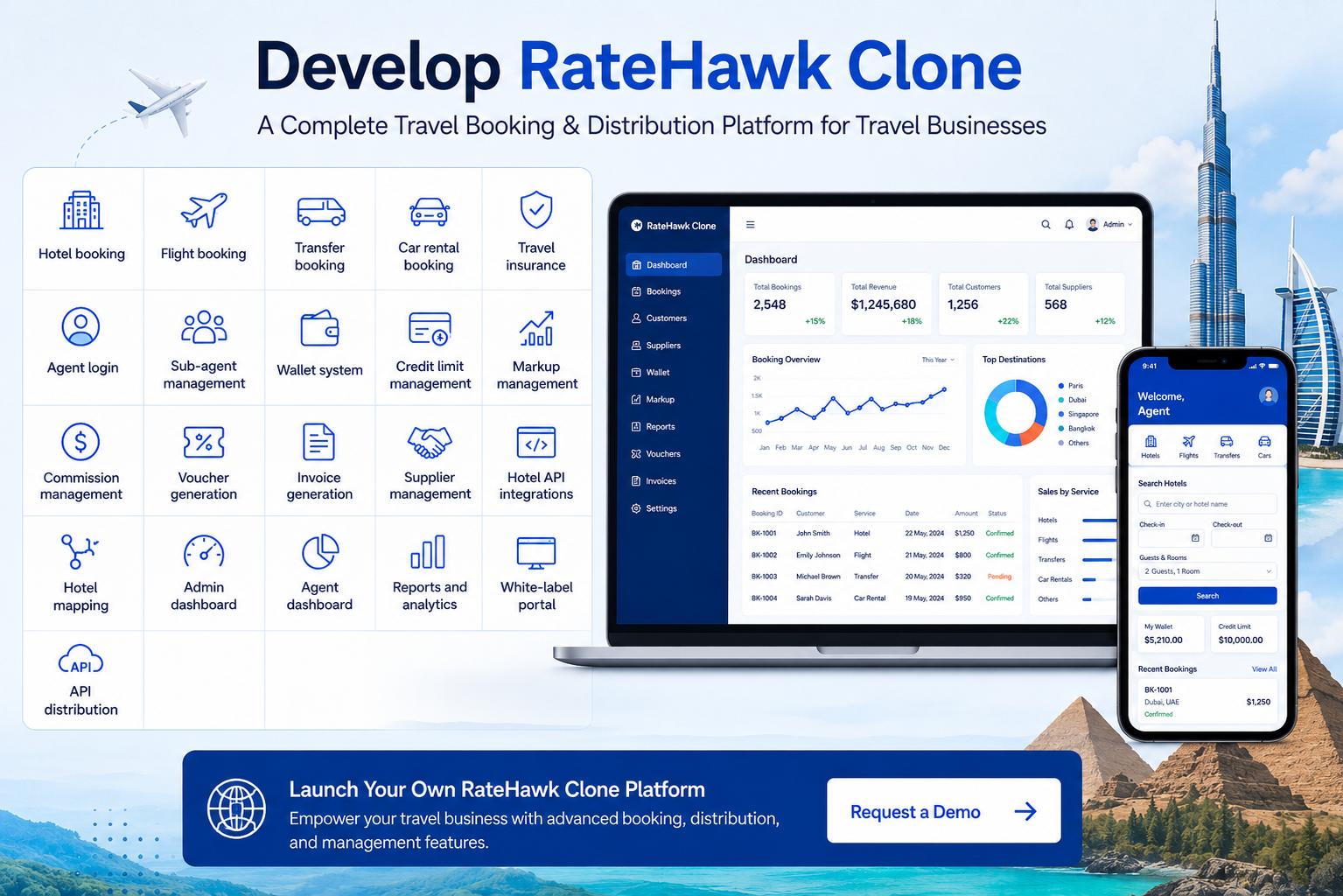
A RateHawk clone can include:
Hotel booking
Flight booking
Transfer booking
Car rental booking
Travel insurance
Agent login
Sub-agent management
Wallet system
Credit limit management
Markup management
Commission management
Voucher generation
Invoice generation
Supplier management
Hotel API integrations
Hotel mapping
Admin dashboard
Agent dashboard
Reports and analytics
White-label portal
API distribution
The main purpose of RateHawk clone development is to build a professional B2B travel booking system where agents can book travel services quickly and platform owners can control inventory, pricing, suppliers, payments, and reports.
Unlike a B2C OTA, a RateHawk-like platform is not only about customer-facing design. It is more focused on agent usability, supplier connectivity, net rates, markup controls, credit limits, booking reliability, and operational efficiency.
Why Develop a RateHawk Clone?
Many travel businesses work with agents and partners.
These agents need fast access to hotel rates, flight options, transfers, car rentals, vouchers, cancellation rules, invoices, and support. If all of this is handled manually, the business becomes slow and difficult to scale.
A RateHawk clone solves this problem.
Agents can log in, search hotels, compare rates, book rooms, download vouchers, manage cancellations, and track payments without depending on the operations team for every booking.
For the platform owner, this reduces manual work and increases booking volume.
A RateHawk-like platform also helps businesses create multiple revenue streams. You can earn through supplier commissions, agent markups, service fees, subscription plans, credit-based bookings, white-label portals, preferred supplier promotions, and API access.
It is useful for travel wholesalers, DMCs, hotel aggregators, travel agencies, OTAs, consolidators, corporate travel companies, and travel technology businesses that want to build a professional B2B travel distribution system.
RateHawk Clone Business Models
Before developing a RateHawk clone, you need to decide the business model. This affects platform features, user roles, API integrations, payment flow, reporting, and final cost.
B2B Travel Agent Portal
In this model, agents log in and book hotels, flights, transfers, and other services for their customers.
This is the most common RateHawk-like business model.
It requires agent registration, admin approval, hotel search, booking flow, wallet, credit limit, markup, vouchers, invoices, cancellations, refunds, and reports.
Hotel Wholesale Platform
A hotel wholesaler can use a RateHawk clone to distribute hotel inventory to agents.
The platform can connect with hotel APIs, bedbanks, direct hotel contracts, DMC suppliers, and channel managers.
Agents can access net rates and book hotels online.
Multi-Service B2B Travel Platform
In this model, the platform includes multiple travel services such as hotels, flights, transfers, car rentals, insurance, and activities.
This gives agents a complete travel booking system.
It also increases revenue because agents can book multiple products from one platform.
DMC Booking Platform
A destination management company can use a RateHawk-like platform to sell hotels, transfers, sightseeing, packages, and local services to travel agents.
This model is useful for inbound travel companies and destination specialists.
Corporate Travel Booking Platform
A RateHawk clone can also be customized for corporate travel agencies.
It can include corporate accounts, approval workflows, employee profiles, travel policies, invoices, cost centers, and company reports.
White-Label Travel Portal
A white-label model allows other travel agencies or partners to use your booking platform under their own branding.
This creates revenue through setup fees, subscriptions, commissions, or revenue sharing.
API Distribution Platform
In this model, your travel inventory is distributed to other OTAs, agencies, and partners through APIs.
This requires API documentation, partner credentials, rate limits, logs, partner pricing, and technical support.
Core Features of a RateHawk Clone
A RateHawk clone should be built for professional travel agents.
The platform should make search, booking, payment, voucher generation, cancellation, reporting, and support smooth and fast.
Agent Panel Features
Agent Registration
Agents should be able to register on the platform by submitting business details.
Agent registration can include company name, contact person, email, phone number, country, address, tax number, business registration document, preferred currency, and payment information.
Admin can review the details and approve or reject the account.
This keeps the platform controlled and suitable for B2B operations.
Agent Login
Approved agents should be able to log in securely.
The login system can include email and password, OTP login, two-factor authentication, and role-based access for agency staff.
Security is important because agents may have wallet balance, credit limits, and access to booking history.
Agent Dashboard
The agent dashboard should show important business information in one place.
It can include wallet balance, credit limit, recent bookings, pending payments, upcoming check-ins, cancellation deadlines, vouchers, support tickets, and special offers.
A clean dashboard helps agents work faster.
Agent Profile Management
Agents should be able to manage their profile, company details, staff users, payment information, saved travelers, booking preferences, currency, and notifications.
For larger agencies, multiple staff members can be added under one agent account.
Sub-Agent Management
Sub-agent management allows master agents to create and manage sub-agents.
Master agents can assign permissions, set booking limits, control markup, view reports, and monitor performance.
This is useful for larger agent networks and B2B distribution.
Hotel Search
Hotel booking is one of the main features of a RateHawk clone.
Agents should be able to search hotels by destination, city, hotel name, check-in date, check-out date, rooms, adults, children, nationality, currency, star rating, and property type.
The search should be fast and accurate.
B2B agents often compare multiple hotel options for customers, so the platform should show relevant results quickly.
Hotel Listing Page
The hotel listing page should show hotel options in a clean layout.
Each hotel card can include hotel name, image, star rating, location, room availability, meal plan, cancellation option, supplier rate, agent rate, final price, and commission or margin indicator.
Agents should be able to compare hotels quickly without too many clicks.
Hotel Detail Page
The hotel detail page should include complete hotel information.
It should show hotel images, description, address, amenities, map location, nearby landmarks, check-in time, check-out time, room types, meal plans, policies, taxes, fees, and cancellation details.
A detailed hotel page helps agents answer customer questions with confidence.
Room Rate Comparison
The system should show different room types and rate plans.
For example:
Standard Room
Deluxe Room
Superior Room
Suite
Room Only
Breakfast Included
Half Board
Full Board
Refundable Rate
Non-Refundable Rate
Agents should be able to compare room options, meal plans, cancellation policies, and final pricing before booking.
Cancellation Policy Display
Cancellation rules must be clearly displayed before booking.
The platform should show free cancellation deadline, cancellation penalty, non-refundable rules, supplier policy, and time zone.
This reduces disputes and builds agent trust.
Hotel Filters
Filters help agents find the right hotel faster.
Common filters include:
Price range
Star rating
Hotel name
Location
Area
Amenities
Meal plan
Refundable rate
Free cancellation
Property type
Supplier
Distance from landmark
Review score
Instant confirmation
Promotion
Good filters improve booking speed and agent satisfaction.
Sorting Options
Sorting options can include lowest price, highest price, recommended, star rating, distance, top rated, best margin, and supplier priority.
For B2B platforms, sorting by best margin can help promote profitable inventory.
Map View
A map view helps agents check hotel locations.
This is useful when customers want hotels near airports, beaches, city centers, landmarks, business districts, event venues, or specific neighborhoods.
Flight Search and Booking
A RateHawk clone can include flight booking as an additional module.
Agents should be able to search flights by origin, destination, date, return date, passenger count, cabin class, and trip type.
The platform should support one-way, round-trip, and multi-city bookings.
Flight results should show airline name, timings, duration, stops, baggage, fare type, refund rules, supplier fare, agent fare, and final price.
Transfer Booking
Transfer booking allows agents to book airport transfers, hotel transfers, private cars, shared transfers, and city transfers.
Agents should be able to search transfers by pickup location, drop location, date, time, passenger count, luggage details, and vehicle type.
This is useful for DMCs and travel agencies that sell complete travel arrangements.
Car Rental Booking
Car rental booking allows agents to reserve vehicles for customers.
Agents should be able to search cars by pickup location, return location, pickup date, return date, vehicle category, supplier, seating capacity, transmission, and price.
Car details should include vehicle type, mileage policy, fuel policy, deposit, insurance, cancellation rules, and supplier terms.
Travel Insurance
Travel insurance can be added as an optional module.
Agents can book insurance based on destination, travel dates, passenger age, coverage type, and policy requirements.
This creates extra revenue and improves customer protection.
Booking Flow
The booking flow should be fast and practical.
Agents should select a service, review supplier rules, enter traveler details, add markup, choose wallet or credit, confirm booking, and download voucher or ticket.
The platform should validate price and availability before final booking confirmation.
Traveler Details
Agents should be able to enter guest or passenger details.
For hotel bookings, details may include guest name, nationality, age, contact number, and special requests.
For flights, details may include passenger name, date of birth, gender, passport details, nationality, and frequent flyer number.
Saved traveler profiles can make repeat bookings faster.
Special Requests
Agents should be able to add special requests for hotels and transfers.
Examples include early check-in, late check-out, twin bed, king bed, honeymoon setup, wheelchair access, airport pickup signboard, or child seat.
The platform should clearly mention that special requests are subject to supplier confirmation.
Voucher Generation
After successful hotel, transfer, or activity booking, the system should generate a voucher.
The voucher should include booking ID, customer name, service details, supplier reference, date, time, hotel address or pickup point, cancellation policy, and emergency contact details.
Agents should be able to download, print, or email vouchers.
Ticket Generation
For flight bookings, the platform should generate ticket details where applicable.
The ticket should include PNR, airline details, route, passenger details, baggage, fare rules, and booking reference.
Invoice Generation
Agents should be able to generate invoices for customers.
The platform should also generate invoices between the platform owner and agent.
Invoices can include net rate, markup, taxes, service fees, commission, payment status, and booking reference.
Agent Wallet
A wallet allows agents to maintain prepaid balance on the platform.
Agents can top up their wallet and use the balance for bookings.
Wallet records should show deposits, deductions, refunds, adjustments, booking references, and remaining balance.
Wallet accuracy is critical in a B2B travel portal.
Credit Limit
Many B2B travel businesses allow trusted agents to book using credit.
Admin can assign credit limits to agents based on business volume, agreement, deposit, or trust level.
The agent dashboard should show available credit, used credit, due amount, due date, and payment history.
Agent Markup
Agents should be able to add their own markup before selling services to customers.
Markup can be fixed or percentage-based.
Agents can generate customer-facing quotations or invoices with their own selling price.
Quotation Management
Agents should be able to create quotations before booking.
A quotation can include hotels, flights, transfers, cars, insurance, net cost, markup, taxes, and final selling price.
This is useful for offline sales, corporate travel, group travel, and customized trips.
Booking Management
Agents should be able to manage all bookings from one dashboard.
They should be able to view confirmed bookings, pending bookings, cancelled bookings, failed bookings, upcoming trips, vouchers, tickets, invoices, payment status, and refund status.
Cancellation and Refund
Agents should be able to cancel eligible bookings and request refunds.
The platform should show cancellation charges before cancellation is confirmed.
Refunds can be credited to wallet, adjusted against credit, or returned to the original payment method based on platform policy.
Booking Reports
Agents should be able to view booking reports, cancellation reports, refund reports, wallet reports, credit reports, invoice reports, and customer-wise booking history.
Reports help agents manage their business properly.
Multi-Currency Support
A RateHawk-like platform may serve agents from different countries.
The system should support multiple currencies and allow admin to control exchange rates.
Agents can view prices in their assigned currency or preferred currency based on business rules.
Multi-Language Support
Multi-language support helps the platform serve agents from different regions.
You can start with one language and add more as the platform expands.
Notifications
Agents should receive notifications for booking confirmation, cancellation updates, refund status, wallet updates, credit limit alerts, payment reminders, offers, and support replies.
Notifications can be sent through email, SMS, WhatsApp, and in-platform alerts.
Admin Panel Features
Admin Dashboard
The admin dashboard should show total bookings, revenue, agents, suppliers, wallet balance, credit usage, cancellations, refunds, failed bookings, top destinations, top hotels, and service-wise performance.
A clean dashboard helps the platform owner track daily operations.
Agent Management
Admin should be able to approve, reject, suspend, and manage agents.
Admin can assign credit limits, update wallet balance, set markup rules, control access, view bookings, and track agent performance.
Agent management is one of the most important parts of a RateHawk clone.
Agent Group Management
Admin should be able to create agent groups such as standard, silver, gold, platinum, enterprise, or custom categories.
Each group can have different markups, commissions, credit limits, currency settings, and access rules.
This helps manage different agent types.
Sub-Agent Control
Admin should be able to control whether master agents can create sub-agents.
Admin can also define permissions, markup limits, booking access, credit rules, and reporting access for sub-agents.
Wallet Management
Admin should be able to manage agent wallet transactions.
This includes deposits, deductions, refunds, manual adjustments, top-up approvals, and wallet balance reports.
Every wallet transaction should be linked with booking references or payment notes.
Credit Limit Management
Admin should be able to assign and manage credit limits.
The system should track used credit, available credit, outstanding amount, overdue payments, due dates, and payment history.
Admin should be able to restrict bookings when credit limits are exceeded.
Supplier Management
Admin should be able to manage hotel suppliers, flight suppliers, transfer providers, car rental companies, insurance providers, bedbanks, DMCs, and API partners.
Supplier management includes API credentials, supplier status, commercial terms, commission rules, priority settings, and performance reports.
API Management
Admin should be able to manage all API integrations from the backend.
This includes enabling or disabling suppliers, updating credentials, monitoring response time, tracking failed searches, checking booking errors, and setting supplier priority.
Hotel Content Management
Admin should be able to manage hotel names, descriptions, images, amenities, addresses, location, policies, and nearby landmarks.
If hotel data comes from APIs, admin may still need tools for mapping, correction, and content control.
Direct Hotel Contract Management
If the platform includes direct hotel contracts, admin should be able to manage hotels, room types, rate plans, allotments, blackout dates, seasonal pricing, stop-sale dates, meal plans, and cancellation policies.
This is useful for DMCs and hotel wholesalers.
Hotel Mapping
Hotel mapping is important when multiple hotel suppliers are integrated.
The same hotel may appear with different names, IDs, addresses, and images from different suppliers.
Hotel mapping helps merge duplicate hotels into one clean listing.
This improves user experience and reduces confusion.
Room Mapping
Room mapping helps compare similar room types across suppliers.
For example, one supplier may call a room “Deluxe Double Room,” while another may call it “Double Deluxe Room.”
Room mapping improves rate comparison but requires deeper logic.
Markup Management
Markup management is one of the main revenue controls.
Admin should be able to set markup by agent, agent group, supplier, destination, hotel, airline, route, room type, booking amount, currency, travel date, or service category.
Markup can be fixed, percentage-based, slab-based, or dynamic.
Commission Management
Admin should be able to manage supplier commissions and agent commissions.
Commission rules can vary by supplier, destination, agent group, booking volume, and business agreement.
Booking Management
Admin should be able to view and manage all bookings from one panel.
The booking management system should show booking ID, agent name, customer details, service type, supplier name, booking status, payment status, cancellation status, refund status, voucher details, and supplier reference.
Cancellation and Refund Management
Admin should be able to review cancellation requests, calculate cancellation charges, approve refunds, reject invalid requests, and track refund status.
Refunds may be credited to wallet, adjusted against credit, or returned to the original payment mode.
Payment Management
Admin should be able to track wallet payments, online payments, bank transfers, credit settlements, refunds, chargebacks, and supplier payouts.
This helps finance teams manage reconciliation.
Supplier Settlement Management
Admin should be able to track payable amounts to suppliers.
The system should calculate supplier cost, platform markup, agent selling price, cancellations, refunds, and settlement status.
Invoice and Tax Management
Admin should be able to generate tax invoices, agent invoices, supplier invoices, receipts, credit notes, and debit notes.
This is important for B2B travel businesses.
Role-Based Access
The platform should support role-based access for internal staff.
For example, support team, finance team, sales team, API team, operations team, and admin users can have different permissions.
This keeps the backend secure and organized.
CMS Management
Admin should be able to manage homepage banners, agent onboarding pages, destination pages, hotel pages, FAQs, blogs, help center pages, terms, privacy policy, and cancellation policy.
CMS pages help with SEO and agent education.
Reports and Analytics
Reports should include bookings, revenue, profit, cancellations, refunds, agent performance, supplier performance, wallet transactions, credit usage, top destinations, top hotels, service-wise sales, and payment reports.
Analytics helps improve pricing, supplier selection, sales strategy, and operations.
Supplier Panel Features
If your RateHawk clone allows suppliers to manage inventory directly, a supplier panel is required.
Supplier Registration
Suppliers should be able to register and submit company details.
Admin can approve suppliers before they are allowed to add inventory.
Inventory Management
Suppliers can manage hotels, transfers, cars, or other services depending on their category.
Rate and Availability Management
Suppliers should be able to update rates, availability, blackout dates, stop-sale dates, seasonal pricing, allotments, and offers.
Booking Dashboard
Suppliers should be able to view bookings, customer details, dates, service details, payment status, cancellation requests, and special requests.
Cancellation Policy Management
Suppliers should be able to define cancellation policies for different services and rate plans.
Admin can review or approve policies before they go live.
Reports and Settlements
Suppliers should be able to view bookings, revenue, commission deductions, pending payouts, completed settlements, cancellations, and performance reports.
Partner API Distribution Features
If you want to distribute your travel inventory to other platforms through API, you need partner API features.
Partner Registration
OTAs, travel agencies, and partners can request API access.
Admin can approve partners and create credentials.
API Key Management
Admin should be able to generate, suspend, rotate, or revoke API keys.
This helps secure the system.
API Documentation
The platform should provide API documentation for hotel search, hotel details, availability, booking, cancellation, voucher, booking status, and other services.
Rate Limit Management
Admin should be able to define API rate limits for each partner.
This protects system performance.
API Logs
Admin should be able to view API usage, search requests, booking requests, errors, response times, and partner activity.
Partner Pricing Rules
Each partner can have different markup, commission, currency, supplier access, and service permissions.
APIs Required for RateHawk Clone Development
A RateHawk clone can integrate multiple travel APIs based on the services included.
Common API categories include:
Hotel search API
Hotel availability API
Hotel content API
Hotel booking API
Hotel cancellation API
Hotel voucher API
Flight search API
Flight booking API
Transfer API
Car rental API
Travel insurance API
Currency conversion API
Payment gateway API
Email API
SMS API
WhatsApp API
Invoice API
Accounting API
Map API
Geocoding API
Notification API
For hotels, the platform may connect with bedbanks, hotel aggregators, DMC suppliers, channel managers, or direct hotel contracts.
For flights, the platform may use GDS APIs, NDC APIs, LCC APIs, airline direct APIs, or consolidator APIs.
For transfers and car rentals, the platform can use supplier APIs or manually managed inventory.
The final API strategy depends on your target market, supplier access, commercial agreements, and business goals.
Advanced Features of a RateHawk Clone
Hotel Mapping Engine
A hotel mapping engine identifies duplicate hotel records from different suppliers and merges them into one clean listing.
This is important when the platform connects multiple hotel APIs.
It improves search quality and avoids repeated hotel listings.
Room Mapping Engine
Room mapping helps compare similar room types across suppliers.
This is complex because room names, meal plans, cancellation rules, and occupancy may differ across APIs.
Dynamic Markup Engine
A dynamic markup engine allows admin to apply advanced pricing rules.
Markup can change based on supplier, destination, hotel, agent group, booking value, travel date, currency, or service type.
Supplier Priority Engine
Admin can prioritize suppliers based on price, availability, commission, cancellation policy, booking success rate, and commercial agreement.
This helps improve profit and booking reliability.
Best Rate Comparison
The platform can compare rates from multiple hotel suppliers and show the best available option.
This helps agents find competitive prices.
Agent Credit Risk Management
The system can track agent credit usage, overdue payments, payment behavior, and booking history.
Admin can set alerts or automatically block risky agents.
White-Label Agent Portal
Agents and partners can get their own branded portal powered by your inventory.
This creates an additional B2B revenue stream.
CRM Integration
CRM integration helps manage agent onboarding, sales follow-ups, support tickets, and relationship management.
Accounting Integration
Accounting integration helps with invoices, credit notes, debit notes, ledgers, tax reports, and payment reconciliation.
AI-Based Hotel Recommendations
AI can recommend hotels based on destination, agent history, customer type, budget, cancellation preference, and margin.
API Failover System
If one supplier API fails, the system can show results from another supplier.
This improves reliability and booking success.
RateHawk Clone Development Cost
The cost to develop a RateHawk clone depends on the platform scope, travel modules, supplier APIs, agent features, and admin controls.
Here is an estimated cost breakdown:
| Platform Type | Estimated Cost |
| Basic B2B Hotel Booking Portal | $60,000 – $90,000 |
| Hotel Portal with Wallet and Credit | $90,000 – $160,000 |
| B2B Travel Platform with Hotels and Transfers | $140,000 – $240,000 |
| Full RateHawk-Like Travel Booking Platform | $220,000 – $320,000+ |
| Enterprise B2B Travel Distribution System | $320,000 – $600,000+ |
A basic version may include agent login, hotel search, hotel booking, wallet, vouchers, invoices, admin panel, and reports.
A mid-level version may include credit limits, sub-agent management, transfers, cancellation, refunds, supplier management, CMS, and payment management.
An advanced RateHawk clone may include flights, car rentals, multiple hotel APIs, hotel mapping, room mapping, dynamic markup, white-label portals, supplier dashboards, partner APIs, accounting integration, and advanced analytics.
Cost Breakdown by Feature
| Feature | Estimated Cost |
| UI/UX Design | $8,000 – $25,000 |
| Agent Panel | $25,000 – $80,000 |
| Admin Panel | $25,000 – $90,000 |
| Hotel Search Module | $20,000 – $70,000 |
| Hotel Booking Module | $25,000 – $80,000 |
| Flight Booking Module | $30,000 – $100,000 |
| Transfer Module | $15,000 – $45,000 |
| Car Rental Module | $15,000 – $45,000 |
| Hotel API Integrations | $40,000 – $150,000 |
| Hotel Mapping Engine | $30,000 – $120,000 |
| Wallet System | $10,000 – $35,000 |
| Credit Limit System | $15,000 – $50,000 |
| Dynamic Markup Engine | $20,000 – $70,000 |
| Supplier Panel | $25,000 – $80,000 |
| White-Label Portal | $30,000 – $100,000 |
| Reports and Analytics | $12,000 – $40,000 |
The actual cost may vary based on supplier APIs, feature complexity, agent hierarchy, financial logic, reporting requirements, design quality, and development team location.
Factors That Affect RateHawk Clone Development Cost
Number of Travel Services
A hotel-only platform costs less than a platform with hotels, flights, transfers, car rentals, insurance, and activities.
Each service requires separate APIs, booking rules, cancellation logic, and reporting.
API Integration Complexity
Travel APIs can be complex.
Each supplier has different documentation, response format, booking flow, pricing logic, cancellation process, and error handling.
Multiple APIs increase development effort.
Hotel Mapping
If multiple hotel suppliers are integrated, hotel mapping may be required.
Hotel mapping helps merge duplicate hotel records and show clean results to agents.
Agent Hierarchy
A simple agent account costs less than a multi-level agent system with master agents, sub-agents, staff users, permissions, and commission rules.
Wallet and Credit Logic
Wallet and credit limit features require accurate financial logic.
The system must track deposits, deductions, refunds, outstanding payments, overdue amounts, and manual adjustments.
Markup Engine
Basic markup is simple.
Dynamic markup based on supplier, destination, agent group, travel date, and booking amount increases development cost.
Supplier Panel
If suppliers manage inventory directly, the platform needs supplier dashboards, rate management, booking management, cancellation rules, and reports.
This increases cost but improves scalability.
White-Label Features
White-label portals, custom branding, partner domains, and agent storefronts add extra development scope.
API Distribution
If you want to provide your inventory through APIs to other partners, the platform needs API documentation, authentication, logs, rate limits, and partner pricing.
This increases development cost.
Reporting Requirements
B2B travel platforms need detailed reports for agents, suppliers, bookings, finance, credits, commissions, and profit.
Advanced reporting increases scope.
Tech Stack for RateHawk Clone Development
The tech stack should support B2B workflows, travel APIs, hotel search, booking, wallet, credit, reporting, and scalable backend systems.
| Layer | Recommended Technologies |
| Frontend | React.js, Next.js, Vue.js |
| Backend | Node.js, Python, .NET, Java |
| Mobile App | Flutter, React Native, Swift, Kotlin |
| Database | PostgreSQL, MySQL, MongoDB |
| Search Engine | Elasticsearch, Solr |
| Cache | Redis |
| Mapping Engine | Python, Java, Machine Learning Models |
| Cloud | AWS, Azure, Google Cloud |
| APIs | Hotel APIs, GDS, NDC, LCC, Transfer APIs |
| Payments | Stripe, PayPal, Razorpay, Adyen |
| Notifications | Firebase, Twilio, SendGrid, WhatsApp API |
| Reports | Custom BI, Metabase, Power BI |
| Accounting | Tally, Zoho Books, QuickBooks, Xero |
The final tech stack depends on your platform scope, supplier APIs, target region, expected booking volume, and long-term roadmap.
Step-by-Step Process to Develop a RateHawk Clone
Step 1: Define the Business Model
Start by deciding whether the platform will be a B2B hotel portal, multi-service travel portal, DMC platform, white-label system, or API distribution platform.
Step 2: Finalize User Roles
Define all user roles.
Common roles include admin, agent, master agent, sub-agent, supplier, finance team, support team, sales team, operations team, and API partner.
Step 3: Finalize Travel Modules
Choose which travel services you want in the first version.
For MVP, you can start with hotels and transfers.
Later, you can add flights, car rentals, insurance, activities, and API distribution.
Step 4: Select API Providers
Choose hotel APIs, flight APIs, transfer APIs, car rental APIs, payment gateways, currency APIs, and notification tools.
Supplier selection affects inventory quality and booking success.
Step 5: Plan Wallet and Credit Logic
Define how wallet balance, deposits, deductions, refunds, credit limits, due dates, and outstanding payments will work.
This should be planned carefully before development.
Step 6: Plan Markup and Commission Rules
Define how markup and commission will be applied.
Rules can be based on agent group, supplier, destination, hotel, route, service type, booking amount, or travel date.
Step 7: Design UI/UX
Design agent dashboard, search pages, hotel detail pages, booking flow, vouchers, invoices, admin panel, supplier panel, wallet pages, credit pages, and reports.
The design should be practical and fast for daily agent use.
Step 8: Build Backend Architecture
Develop backend systems for users, agents, suppliers, APIs, bookings, wallet, credit, markups, payments, cancellations, refunds, invoices, and reports.
Step 9: Integrate APIs
Integrate hotel APIs, flight APIs, transfer APIs, car rental APIs, payment APIs, currency APIs, email, SMS, WhatsApp, and accounting APIs where required.
Step 10: Test and Launch
Test hotel search, rate accuracy, booking flow, wallet deductions, credit limits, markups, vouchers, invoices, cancellations, refunds, supplier errors, API performance, and reports.
After launch, monitor bookings, supplier performance, failed searches, payment issues, agent feedback, and support tickets.
Development Timeline
The timeline to develop a RateHawk clone depends on platform complexity.
| Development Scope | Estimated Timeline |
| Basic B2B Hotel Portal | 4 – 6 Months |
| Hotel Portal with Wallet and Credit | 6 – 9 Months |
| B2B Platform with Hotels and Transfers | 8 – 12 Months |
| Full RateHawk-Like Platform | 12 – 18 Months |
| Enterprise B2B Travel Distribution System | 18 – 24+ Months |
A phased approach is usually better.
You can launch with hotel booking, agent login, wallet, vouchers, and admin panel first.
Later, you can add transfers, flights, car rentals, credit limits, sub-agents, supplier panels, hotel mapping, white-label portals, and API distribution.
Monetization Models for a RateHawk Clone
Supplier Commission
The platform can earn commission from hotel suppliers, airlines, transfer companies, car rental suppliers, and insurance providers.
Agent Markup
Admin can add markup before showing prices to agents.
This is one of the main revenue sources.
Service Fees
The platform can charge service fees for bookings, cancellations, urgent support, documentation, or payment processing.
Subscription Fees
Agents can pay monthly or yearly fees to access the platform.
Different subscription plans can offer different rates, features, or credit limits.
Credit-Based Revenue
The platform can provide credit limits to trusted agents and charge fees based on business terms.
White-Label Fees
Agents or partners can pay setup fees and monthly fees for branded portals.
Featured Inventory
Suppliers can pay for featured hotel placement, promoted transfers, or sponsored visibility.
Travel Add-Ons
The platform can earn from insurance, transfers, car rentals, activities, and other add-ons.
API Access Fees
If your platform distributes inventory through APIs, you can charge API access fees, monthly fees, or revenue share.
MVP Features for a RateHawk Clone
If you want to launch quickly, build an MVP first.
The MVP can include:
Agent registration
Admin approval
Agent login
Hotel search
Hotel detail page
Room rate display
Hotel booking
Agent wallet
Basic markup
Voucher generation
Invoice generation
Booking management
Cancellation request
Admin dashboard
Supplier management
CMS pages
Email notifications
Basic reports
This version is enough to start B2B hotel distribution.
After launch, you can add credit limit, sub-agent management, transfers, flights, car rentals, multiple hotel APIs, hotel mapping, supplier dashboard, payment gateway, white-label portals, and advanced analytics.
Challenges in RateHawk Clone Development
API Reliability
Travel APIs can fail, delay, or return incomplete data.
The system needs retries, monitoring, error handling, and fallback options.
Hotel Mapping
If multiple hotel APIs are used, duplicate hotels can appear.
Hotel mapping is needed to show clean results.
Rate Accuracy
Hotel and flight prices can change quickly.
The platform must validate price and availability before final booking.
Wallet and Credit Accuracy
B2B financial logic must be accurate.
Any error in wallet balance, credit limit, refund, or outstanding amount can create disputes.
Cancellation Rules
Different suppliers have different cancellation policies.
The platform must display these rules clearly and process refunds correctly.
Markup Management
Markup rules must work properly across suppliers, agents, destinations, and currencies.
Incorrect markup can affect profitability.
Supplier Settlement
The system must track supplier payments, commissions, refunds, cancellations, and settlements.
Agent Trust
Agents will use the platform only if rates are competitive, vouchers are reliable, support is fast, and financial records are transparent.
How to Make a RateHawk Clone Successful
To make a RateHawk clone successful, focus on agent trust, strong inventory, competitive pricing, and operational reliability.
Agents need fast search, clear policies, instant vouchers, good rates, credit support, and quick issue resolution.
A focused launch strategy can help you grow faster.
Instead of launching every travel service from day one, start with one strong product category.
For example, you can focus on:
B2B hotel booking
Hotel + transfer booking
DMC inventory
Corporate hotel booking
Luxury hotel distribution
Budget hotel distribution
Regional agent network
White-label hotel portals
API-based hotel distribution
Inbound travel services
You should also invest in agent onboarding.
Agents need proper training, sales support, and confidence before they move regular bookings to your platform.
Final Cost Estimate
On average, RateHawk clone development can cost between $60,000 and $320,000+.
A basic B2B hotel booking portal may cost around $60,000 to $90,000.
A mid-level RateHawk-like platform with hotel booking, wallet, credit limit, transfers, markup, vouchers, invoices, admin dashboard, supplier management, and reports may cost around $120,000 to $220,000.
An advanced B2B travel platform with hotels, flights, transfers, car rentals, multiple APIs, hotel mapping, dynamic markup, sub-agents, supplier panels, and white-label portals may cost around $220,000 to $320,000+.
An enterprise-level B2B travel distribution system with API distribution, partner management, advanced analytics, accounting integration, and scalable infrastructure can cost $450,000 or more.
Conclusion
Developing a RateHawk clone is a strong opportunity for travel businesses that want to build a professional B2B travel booking platform.
A RateHawk-like portal allows agents to search hotels, compare room rates, book transfers, reserve cars, generate vouchers, manage cancellations, use wallet or credit, and access reports from one dashboard.
For businesses, it creates revenue opportunities through supplier commissions, agent markups, service fees, subscriptions, credit-based bookings, white-label portals, featured inventory, travel add-ons, and API access.
The final cost to develop a RateHawk clone depends on travel modules, supplier APIs, agent hierarchy, wallet system, credit limit, markup engine, hotel mapping, admin controls, and scalability requirements.
If you want to start lean, launch an MVP with agent registration, hotel search, booking, wallet, basic markup, voucher generation, invoice generation, admin dashboard, and basic reports.
Later, you can add credit limits, sub-agents, transfers, flights, car rentals, multiple APIs, hotel mapping, supplier dashboard, white-label portals, accounting integration, and API distribution.
A successful RateHawk clone is not just a hotel booking portal. It is a complete B2B travel distribution system that helps agents book faster and helps your business scale through travel technology.
FAQs
How much does it cost to develop a RateHawk clone?
The cost to develop a RateHawk clone usually ranges between $60,000 and $320,000+. The final cost depends on travel modules, APIs, agent features, wallet system, credit limit, markup engine, admin panel, supplier management, and customization requirements.
How long does it take to develop a RateHawk clone?
A basic B2B hotel portal can take around 4 to 6 months. A platform with wallet and credit features may take 6 to 9 months, while a full RateHawk-like platform with multiple services can take 12 to 18 months or more.
What is a RateHawk clone?
A RateHawk clone is a custom B2B travel booking platform inspired by RateHawk. It allows agents to search, compare, book, pay, cancel, and manage hotels, flights, transfers, cars, and other travel services.
What features should a RateHawk clone include?
A RateHawk clone should include agent login, hotel search, booking flow, wallet, credit limit, markup management, voucher generation, invoice generation, cancellation, refund, admin dashboard, supplier management, and reports.
Can a RateHawk clone include flights and transfers?
Yes. A RateHawk clone can include hotels, flights, transfers, car rentals, insurance, and other travel services based on your business model and API access.
What APIs are needed for RateHawk clone development?
A RateHawk clone may need hotel APIs, flight APIs, transfer APIs, car rental APIs, insurance APIs, payment APIs, currency APIs, email APIs, SMS APIs, WhatsApp APIs, invoice APIs, and accounting APIs.
How does a RateHawk clone make money?
A RateHawk clone can make money through supplier commissions, agent markups, service fees, subscriptions, credit-based booking fees, white-label setup fees, featured inventory, travel add-ons, and API access fees.
Can agents get credit limits in a RateHawk clone?
Yes. Admin can assign credit limits to trusted agents. Agents can book using available credit and settle payments later based on agreed business terms.
Can a RateHawk clone offer white-label portals?
Yes. A RateHawk clone can include white-label portals where agents or partners sell travel inventory under their own branding.
What is the best way to start RateHawk clone development?
The best way to start is with an MVP that includes agent registration, hotel search, hotel booking, wallet, basic markup, voucher generation, invoice generation, admin dashboard, supplier management, and reports. Advanced features can be added later.