


The cost to develop a Kayak clone usually ranges between $45,000 and $220,000+, depending on the travel modules, API integrations, metasearch logic, booking flow, mobile app requirements, admin panel, affiliate tracking, and overall platform complexity. A basic Kayak-like travel comparison website with flight and hotel search can be developed at a lower cost, while a full-scale travel metasearch platform with flights, hotels, cars, packages, price alerts, flexible dates, direct booking, mobile apps, analytics, and multiple supplier integrations requires a higher budget.
Kayak is one of the most popular travel search and comparison platforms because it helps users compare flights, hotels, car rentals, vacation packages, and travel deals from multiple providers in one place. Instead of visiting several airline, hotel, and OTA websites separately, users can search once and compare many options quickly.
That is why many travel startups, OTAs, affiliate travel businesses, airline consolidators, and travel technology companies want to develop a Kayak clone.
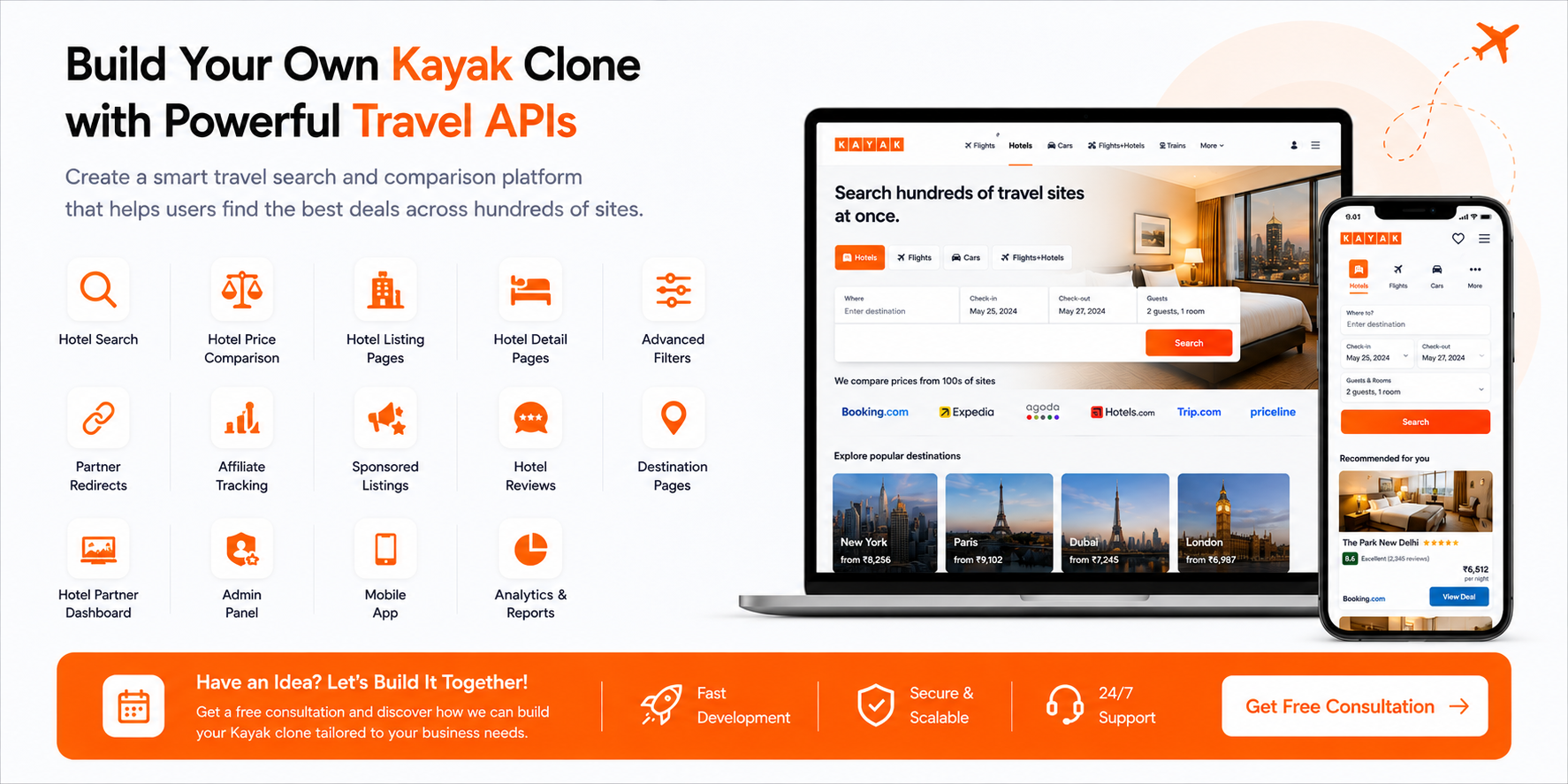
A Kayak clone is not a direct copy of Kayak. It is a custom travel metasearch platform inspired by Kayak’s search experience, comparison model, partner redirection flow, and multi-service travel structure. The platform can be developed as a flight comparison website, hotel comparison platform, car rental comparison app, affiliate travel portal, or full travel metasearch engine.
For businesses, developing a Kayak-like platform can create multiple revenue opportunities. You can earn through affiliate commissions, cost-per-click partnerships, sponsored listings, direct booking margins, travel ads, insurance, and add-on services.
In this guide, we will explain how to develop a Kayak clone, including its features, cost, tech stack, travel APIs, business model, monetization options, timeline, and key factors that affect the final travel metasearch platform development cost.
What Is a Kayak Clone?
A Kayak clone is a travel metasearch platform that allows users to search and compare travel services from different providers.
It does not only show inventory from one supplier. Instead, it collects travel options from airlines, hotels, car rental companies, OTAs, aggregators, and travel suppliers.
Users can compare prices, timing, availability, policies, ratings, and booking providers before making a decision.
A Kayak clone can include:
Flight comparison
Hotel comparison
Car rental comparison
Vacation package search
Travel deals
Price alerts
Flexible date search
Affiliate redirects
Direct booking
User accounts
Mobile apps
Admin dashboard
Partner tracking
Analytics and reports
The platform can work as a redirect-based metasearch engine, direct booking platform, affiliate travel website, or hybrid OTA model.
In a redirect-based model, users compare prices on your platform and then visit the partner website to complete the booking.
In a direct booking model, users complete the booking directly on your platform through integrated travel APIs.
Both models are useful, but the cost and technical complexity are different.
Why Develop a Kayak Clone?
Travelers want convenience, price transparency, and faster comparison.
Before booking a trip, users usually compare different airlines, hotels, routes, dates, and providers. Doing this manually across multiple platforms takes time.
A Kayak-like platform solves this problem by bringing multiple travel options into one search experience.
Users can compare flights, hotels, cars, and travel packages from one interface. They can filter results, track prices, check flexible dates, and choose the option that gives the best value.
For businesses, a Kayak clone can become a powerful travel discovery platform.
It can attract users at the research stage and send them to booking partners. It can also support direct bookings if the platform connects with travel APIs.
A Kayak-like platform also has strong SEO potential. Route pages, destination pages, hotel comparison pages, airport pages, travel guides, and deal pages can attract organic traffic over time.
This makes Kayak clone development a strong option for businesses that want to enter the online travel market without necessarily operating like a traditional OTA from day one.
Kayak Clone Business Models
Before starting Kayak clone development, you need to choose the right business model. This affects features, APIs, partner management, monetization, and development cost.
Travel Metasearch Model
In a travel metasearch model, the platform compares flights, hotels, cars, and packages from multiple providers.
Users search on your platform but complete the booking on the partner website.
This model is suitable for affiliate travel businesses and comparison platforms.
It requires strong search logic, provider comparison, redirect tracking, affiliate links, partner reports, and analytics.
Direct Booking Model
In a direct booking model, users search and book travel services on your platform.
This requires deeper API integration for flights, hotels, cars, payments, ticketing, vouchers, cancellations, refunds, and booking management.
This model is more complex but gives better control over customer experience and revenue margins.
Hybrid Model
A hybrid Kayak clone supports both redirect-based booking and direct booking.
For some suppliers, users may be redirected to a partner website. For others, they may complete the booking directly on your platform.
This model gives flexibility and helps businesses work with different types of travel providers.
Affiliate Travel Platform
An affiliate travel platform earns money by sending users to airlines, OTAs, hotel websites, car rental platforms, or travel partners.
Revenue can be generated through cost per click, cost per lead, or completed booking commission.
This model needs accurate tracking, partner management, and conversion reporting.
Full Travel Marketplace
A full travel marketplace includes multiple services such as flights, hotels, car rentals, holiday packages, activities, insurance, and transfers.
This model requires more features, more APIs, more panels, and a stronger backend architecture.
Core Features of a Kayak Clone
A Kayak clone should make travel comparison fast, simple, and useful.
The platform should help users search once, compare many options, and choose the best provider.
User Panel Features
User Registration and Login
Users should be able to create an account using email, phone number, OTP, Google login, Apple login, or social login.
A Kayak-like platform can allow users to search without logging in, but registration is useful for saved searches, price alerts, booking history, preferences, and personalized recommendations.
The user profile should include saved travelers, preferred airports, currency, language, saved hotels, search history, alerts, and communication preferences.
Flight Search
Flight search is one of the main features of a Kayak clone.
Users should be able to search flights by origin, destination, departure date, return date, passenger count, cabin class, and trip type.
The platform should support one-way, round-trip, and multi-city search.
Flight results should show airline name, departure time, arrival time, total duration, stops, baggage details, fare type, refund rules, and price.
Flight Comparison
The platform should compare flight prices from multiple providers.
If the same flight is available from different OTAs or airlines, users should be able to see the price difference.
This helps users choose the cheapest or most trusted booking provider.
The comparison system should display provider name, price, booking condition, baggage inclusion, and redirect or booking button.
Flexible Date Search
Flexible date search allows users to compare travel prices across different dates.
This feature is important because many travelers can save money by shifting their travel date by one or two days.
The platform can show flexible fares through a date grid, calendar view, or monthly price chart.
Nearby Airport Search
Nearby airport search allows users to compare flights from airports close to the selected city.
For example, a user searching from New York may compare flights from JFK, Newark, and LaGuardia.
This feature improves search flexibility and helps users find cheaper options.
Hotel Search
The hotel search module allows users to search hotels by destination, check-in date, check-out date, rooms, guests, price range, star rating, amenities, and property type.
Hotel results should show hotel name, images, rating, review score, location, amenities, cancellation option, price, and booking providers.
Hotel Comparison
A Kayak clone should allow users to compare hotel prices from multiple hotel suppliers and OTAs.
The same hotel may be available at different rates on different platforms.
The comparison feature helps users find the best available deal.
Hotel comparison should show provider name, room type, cancellation policy, meal plan, taxes, and final price.
Car Rental Search
Car rental comparison is another important feature of a Kayak-like platform.
Users should be able to search cars by pickup location, drop-off location, pickup date, return date, car type, transmission, passenger capacity, and supplier.
The platform should show vehicle options, rental company, price, policies, mileage, insurance, and booking provider.
Vacation Package Search
Vacation packages help users compare bundled travel options.
A package module can include flights, hotels, transfers, activities, meals, and sightseeing.
This feature is useful for travel companies that want to sell complete travel experiences instead of only individual bookings.
Explore Destination Feature
An explore feature helps users discover destinations based on budget, date, origin city, weather, or travel interest.
For example, users can search for beach holidays under a certain budget or weekend trips from a selected city.
This improves user engagement and supports travel inspiration.
Price Alerts
Price alerts allow users to track flight, hotel, or route prices.
When the price changes, the platform sends a notification through email, SMS, WhatsApp, or mobile push notification.
This feature brings users back to the platform and improves conversion chances.
Saved Searches
Users should be able to save searches and continue later.
Saved searches are useful for users who are comparing multiple travel options before booking.
They also help the platform understand user intent and send relevant offers.
Filters and Sorting
Filters help users find the right option faster.
Common flight filters include airline, price, stops, departure time, arrival time, duration, baggage, airport, and provider.
Common hotel filters include price, star rating, location, guest rating, amenities, property type, free cancellation, breakfast, and payment option.
Sorting options should include cheapest, fastest, best value, top rated, most popular, and recommended.
Booking Redirect
In a metasearch model, users are redirected to the airline, OTA, hotel website, or car rental partner after selecting an option.
The redirect should include affiliate tracking parameters so the business can track clicks, conversions, and revenue.
The user experience should be smooth and transparent.
Direct Booking Flow
If the platform supports direct booking, users should be able to book flights, hotels, cars, or packages from your platform.
The direct booking flow includes traveler details, booking review, payment, confirmation, vouchers, cancellations, refunds, and support.
This increases development cost but gives stronger control over the customer experience.
Reviews and Ratings
Hotel and car rental reviews help users make better decisions.
The platform can show reviews from supplier data, partner APIs, or verified users.
If direct reviews are added, admin moderation is required.
Coupons and Deals
Coupons and travel deals help increase conversion.
The platform should support promo codes, seasonal offers, destination deals, route-based discounts, partner deals, and app-only discounts.
Multi-Currency Support
If your Kayak clone targets international users, multi-currency support is important.
Users should be able to view prices in their preferred currency.
Currency conversion should be updated regularly.
Multi-Language Support
Multi-language support helps the platform serve users from different countries.
You can start with one language and add more languages as the platform expands.
Booking Management
If the platform supports direct booking, users need a booking dashboard.
They should be able to view upcoming trips, completed trips, cancelled bookings, invoices, flight tickets, hotel vouchers, car rental confirmations, and refund status.
Customer Support
Support options can include help center, chatbot, live chat, email support, ticket system, phone support, and WhatsApp support.
For redirect-based platforms, support may be limited. For direct booking platforms, support needs to be stronger.
Admin Panel Features
Admin Dashboard
The admin dashboard should show searches, clicks, bookings, revenue, partner performance, top routes, top hotels, top destinations, API errors, user activity, and conversion data.
For a travel metasearch platform, analytics is very important because revenue depends on search traffic, partner clicks, and booking conversions.
User Management
Admin should be able to manage registered users, saved searches, alerts, booking history, account status, and support requests.
User data helps improve marketing and personalization.
Supplier Management
Admin should be able to manage airlines, OTAs, hotel suppliers, car rental providers, affiliate partners, and API providers.
Supplier management includes API credentials, supplier priority, commission terms, redirect links, performance tracking, and status controls.
API Management
Admin should be able to monitor API health, response time, errors, failed searches, missing prices, supplier downtime, and data accuracy.
For platforms with multiple APIs, this feature is very important.
Affiliate Partner Management
If the Kayak clone works on affiliate revenue, admin should be able to manage partner links, tracking IDs, click reports, commission rates, and conversion data.
The system should track outbound clicks, route, destination, provider, device, session, and campaign source.
Booking Management
For direct booking models, admin should be able to manage all bookings.
This includes flight bookings, hotel reservations, car rentals, cancellations, refunds, payment status, supplier confirmation, and customer communication.
Markup Management
If your platform supports direct booking, admin should be able to set markup by supplier, airline, route, hotel, destination, car rental provider, user type, and booking value.
Markup control helps protect profitability.
Sponsored Listing Management
The platform can allow selected partners to appear higher in results.
Admin should be able to manage sponsored listings, featured providers, promoted routes, hotel promotions, and destination campaigns.
Sponsored results should be clearly marked for transparency.
Content Management
The CMS should allow admin to manage blogs, destination guides, route pages, airport pages, hotel pages, FAQs, terms, privacy policy, banners, and landing pages.
Content is important for organic traffic growth.
Price Alert Management
Admin should be able to manage active alerts, triggered alerts, notification frequency, failed notifications, and user response.
This helps improve engagement.
Payment Management
For direct booking platforms, admin should be able to track successful payments, failed payments, refunds, wallet transactions, chargebacks, and settlements.
Reports and Analytics
Reports should include searches, clicks, bookings, revenue, affiliate income, top routes, top destinations, supplier performance, user behavior, conversion rate, and campaign results.
Analytics helps optimize partner placement, SEO targeting, and revenue strategy.
Travel APIs Required for a Kayak Clone
Travel APIs are the backbone of a Kayak-like platform.
The APIs you need depend on your services and booking model.
Common API categories include:
Flight search API
Flight pricing API
Flight booking API
Hotel search API
Hotel booking API
Car rental API
Package API
Airport data API
Airline content API
Hotel content API
Currency exchange API
Payment gateway API
Email and SMS API
Map API
Review API
Affiliate tracking API
For flights, the platform may connect with GDS APIs, NDC APIs, LCC APIs, airline direct APIs, consolidator APIs, or OTA partner APIs.
For hotels, it may connect with bedbanks, hotel aggregators, channel managers, DMC suppliers, direct hotel contracts, or hotel chain APIs.
For car rentals, it may connect with car rental suppliers, global mobility providers, or local rental companies.
The quality of API integration directly affects platform performance, fare accuracy, booking success, and customer experience.
Advanced Features of a Kayak Clone
AI-Based Recommendations
AI can recommend flights, hotels, destinations, and travel deals based on user behavior, search history, budget, location, and travel preferences.
This improves personalization and conversion.
Price Prediction
Price prediction can help users understand whether flight or hotel prices may increase or decrease.
This feature requires historical pricing data, route trends, seasonality, and demand signals.
Dynamic Packaging
Dynamic packaging allows users to combine flights, hotels, cars, and activities into one trip.
This feature is useful for increasing average booking value.
Route-Based SEO Pages
The platform can generate SEO pages for popular travel routes.
Examples include:
Flights from New York to London
Cheap flights from Delhi to Dubai
Hotels in Bangkok
Car rentals in Los Angeles
These pages help attract organic traffic.
Destination Guides
Destination guides can include travel tips, attractions, hotel areas, best time to visit, airport information, and popular routes.
This supports SEO and improves user experience.
Mobile App
A Kayak clone mobile app helps increase repeat usage.
Users can save searches, create alerts, receive push notifications, compare options, and book faster.
Mobile apps are useful for engagement and retention.
Push Notifications
Push notifications can be used for price drops, saved search updates, booking reminders, travel deals, and personalized offers.
API Cache System
Travel APIs can be expensive and rate-limited.
A cache system can improve search speed and reduce API load.
However, cached prices must be refreshed properly to avoid showing outdated fares.
Partner Ranking Algorithm
The platform can rank booking providers based on price, commission, conversion rate, availability, user trust, and sponsored placement.
This helps balance user value and business revenue.
White-Label Partner System
A white-label system allows other travel businesses to use your platform under their own branding.
This can create additional B2B revenue.
Kayak Clone Development Cost
The cost to develop a Kayak clone depends on the number of services, APIs, booking model, design complexity, admin panel, mobile apps, and scalability requirements.
Here is an estimated cost breakdown:
| Platform Type | Estimated Cost |
| Basic Travel Comparison Website | $45,000 – $75,000 |
| Flight + Hotel Metasearch Platform | $75,000 – $130,000 |
| Travel Metasearch Website + Mobile App | $120,000 – $180,000 |
| Direct Booking Travel Platform | $140,000 – $220,000+ |
| Enterprise Kayak-Like Platform | $220,000 – $350,000+ |
A basic version may include flight search, hotel search, filters, comparison, redirect links, admin panel, and basic analytics.
A mid-level platform may include multiple APIs, price alerts, affiliate tracking, CMS, saved searches, flexible dates, and reporting.
An advanced Kayak clone may include direct booking, mobile apps, car rentals, packages, AI recommendations, price prediction, dynamic packaging, multi-currency, multi-language, and advanced analytics.
Cost Breakdown by Feature
| Feature | Estimated Cost |
| UI/UX Design | $6,000 – $20,000 |
| Flight Search Module | $15,000 – $45,000 |
| Hotel Search Module | $12,000 – $40,000 |
| Car Rental Module | $10,000 – $30,000 |
| Travel API Integration | $20,000 – $80,000 |
| Affiliate Tracking System | $8,000 – $25,000 |
| Price Alerts | $8,000 – $22,000 |
| Flexible Date Search | $8,000 – $25,000 |
| Direct Booking Flow | $25,000 – $80,000 |
| Admin Panel | $15,000 – $45,000 |
| Mobile App Development | $35,000 – $100,000 |
| Reports and Analytics | $8,000 – $30,000 |
The actual cost can vary based on platform scope, supplier documentation, development team location, design quality, and business requirements.
Factors That Affect Kayak Clone Development Cost
Number of Travel Modules
A flight-only comparison platform costs less than a platform with flights, hotels, cars, packages, transfers, and activities.
Each module requires separate search logic, API integration, filters, content structure, and booking flow.
Metasearch vs Direct Booking
A redirect-based metasearch platform costs less than a direct booking platform.
Direct booking requires passenger details, payment, supplier confirmation, cancellation, refunds, vouchers, and support.
Number of API Integrations
The more APIs you integrate, the higher the development cost.
Multiple APIs require data normalization, duplicate removal, supplier priority, error handling, and performance optimization.
Affiliate Tracking Requirements
If revenue depends on affiliate clicks and partner conversions, tracking must be accurate.
This requires click IDs, session tracking, partner reports, conversion tracking, and fraud prevention.
Mobile App Development
Adding Android and iOS apps increases cost.
However, mobile apps improve price alert engagement, saved searches, push notifications, and repeat usage.
UI/UX Complexity
Travel comparison platforms need clean and fast interfaces.
Users should be able to compare many options without confusion.
Better UI/UX design improves conversion but requires more effort.
Performance and Scalability
A Kayak-like platform must handle large search volume and real-time API responses.
Caching, load balancing, cloud infrastructure, and monitoring can increase cost but are important for long-term success.
AI and Personalization
AI recommendations, price prediction, and smart ranking increase development cost.
These features need data collection, machine learning logic, testing, and optimization.
Tech Stack for Kayak Clone Development
The tech stack should support fast search, multiple APIs, large data processing, affiliate tracking, secure payments, and scalability.
| Layer | Recommended Technologies |
| Frontend | React.js, Next.js, Vue.js |
| Mobile App | Flutter, React Native, Swift, Kotlin |
| Backend | Node.js, Python, .NET, Java |
| Database | PostgreSQL, MySQL, MongoDB |
| Search Engine | Elasticsearch, Solr |
| Cache | Redis |
| Cloud | AWS, Azure, Google Cloud |
| APIs | GDS, NDC, LCC, Hotel APIs, Car APIs |
| Payment | Stripe, PayPal, Razorpay, Adyen |
| Notifications | Firebase, Twilio, SendGrid |
| Analytics | GA4, Mixpanel, Amplitude, Custom BI |
The final tech stack depends on your budget, expected traffic, API requirements, and long-term product roadmap.
Step-by-Step Process to Develop a Kayak Clone
Step 1: Define the Platform Model
Start by deciding whether the platform will be a metasearch engine, direct booking platform, affiliate website, or hybrid OTA.
This decision affects features, APIs, and cost.
Step 2: Finalize Travel Modules
Choose the services you want to include in the first version.
For an MVP, you can start with flights and hotels.
Later, you can add car rentals, packages, transfers, activities, and insurance.
Step 3: Select API Providers
Choose flight APIs, hotel APIs, car rental APIs, affiliate partners, and payment gateways.
API selection is one of the most important steps in Kayak clone development.
Step 4: Plan UI/UX Design
Design a clean, fast, and comparison-friendly interface.
The design should make search, filtering, comparison, and booking decisions simple.
Step 5: Build Backend Architecture
Develop the backend for API handling, user management, search logic, supplier normalization, partner tracking, alerts, bookings, and reports.
Step 6: Integrate Travel APIs
Integrate flight, hotel, car rental, currency, payment, notification, and affiliate tracking APIs.
Each API should be tested carefully.
Step 7: Develop Frontend and Mobile App
Build the customer-facing website and mobile app.
The platform should be responsive, fast, and easy to use.
Step 8: Build Admin Panel
Create the admin panel for managing users, partners, suppliers, APIs, content, sponsored listings, reports, and bookings.
Step 9: Test the Platform
Test search results, filters, redirects, booking flow, payment flow, price alerts, API errors, mobile responsiveness, and performance.
Step 10: Launch and Optimize
After launch, monitor traffic, clicks, conversions, revenue, supplier performance, API errors, and user behavior.
Continuous optimization is important for metasearch platforms.
Development Timeline
The timeline to develop a Kayak clone depends on the project scope.
| Development Scope | Estimated Timeline |
| Basic Travel Comparison Website | 3 – 4 Months |
| Flight + Hotel Metasearch Platform | 4 – 6 Months |
| Website + Mobile App | 6 – 8 Months |
| Direct Booking Platform | 7 – 10 Months |
| Enterprise Kayak-Like Platform | 10 – 14+ Months |
A phased approach is usually better.
You can launch an MVP with flights, hotels, comparison, redirects, admin panel, and analytics.
Later, you can add mobile apps, direct booking, cars, packages, price prediction, and AI recommendations.
Monetization Models for a Kayak Clone
Affiliate Commission
The platform can earn commission when users book through partner airlines, OTAs, hotel websites, or car rental companies.
Cost Per Click
Partners can pay for each user click or redirect sent from your platform.
This model works well for high-traffic travel comparison websites.
Sponsored Listings
Airlines, hotels, OTAs, or car rental companies can pay for better visibility in search results.
Sponsored listings should be clearly marked.
Direct Booking Markup
If users book directly on your platform, you can add markup or service fees.
This gives better revenue control.
Display Advertising
The platform can earn through banner ads, native ads, destination promotions, and travel-related ad campaigns.
Travel Add-Ons
You can sell add-ons such as travel insurance, baggage, seat selection, airport transfers, lounge access, and visa assistance.
Subscription for Partners
Travel businesses can pay for premium placement, analytics, white-label access, or lead generation.
Data and Insights
Aggregated travel demand insights can be valuable for partners, but user privacy and compliance must be handled properly.
MVP Features for a Kayak Clone
If you want to launch quickly, you can start with an MVP.
The MVP can include:
Flight search
Hotel search
Basic filters
Price comparison
Partner redirects
User registration
Saved searches
Price alerts
Admin dashboard
Affiliate tracking
CMS pages
Basic reports
This version is enough to test the market, build traffic, and validate the revenue model.
After the MVP, you can add direct booking, mobile apps, car rentals, vacation packages, AI recommendations, dynamic packaging, and multi-language support.
Challenges in Kayak Clone Development
API Data Accuracy
Travel prices change quickly.
The platform must refresh prices and availability properly to avoid showing outdated information.
Supplier Normalization
Different suppliers send data in different formats.
The platform must normalize results so users can compare them easily.
Search Speed
Users expect fast results.
Slow flight or hotel search can reduce engagement and increase bounce rate.
Affiliate Tracking Accuracy
Affiliate revenue depends on proper tracking.
If clicks and conversions are not tracked correctly, the business may lose revenue.
Competition
Travel comparison is competitive.
The platform needs a clear niche, strong SEO, better user experience, or regional advantage.
Price Transparency
Users dislike hidden fees.
The platform should show taxes, fees, baggage, cancellation rules, and final pricing as clearly as possible.
How to Make a Kayak Clone Successful
To make a Kayak clone successful, focus on speed, trust, comparison quality, and SEO.
Users should feel that your platform helps them find better travel options faster.
The search experience should be simple.
The filters should be useful.
The prices should be clear.
The redirects should be smooth.
The platform should also have a strong content strategy.
Route pages, destination guides, airport pages, airline pages, hotel comparison pages, and car rental pages can help bring organic traffic.
You can also start with a niche instead of competing everywhere.
For example, you can focus on:
Cheap international flights
Student travel
Business travel
Regional flight comparison
Hotel comparison in one country
Car rental comparison
Last-minute travel deals
Budget airline comparison
A focused positioning helps you grow faster and compete better.
Final Cost Estimate
On average, Kayak clone development can cost between $45,000 and $220,000+.
A basic travel comparison website with flights, hotels, filters, partner redirects, and admin panel may cost around $45,000 to $75,000.
A mid-level Kayak-like platform with multiple APIs, price alerts, affiliate tracking, CMS, flexible dates, and analytics may cost around $75,000 to $130,000.
An advanced platform with direct booking, mobile apps, cars, packages, AI recommendations, multi-currency, multi-language, and advanced reporting may cost around $140,000 to $220,000+.
Enterprise-level travel metasearch platforms with global supplier integrations, high scalability, partner dashboards, white-label systems, and advanced personalization can cost $300,000 or more.
Conclusion
Developing a Kayak clone is a strong opportunity for businesses that want to enter the travel comparison, metasearch, or online booking market.
A Kayak-like platform allows users to search flights, hotels, cars, and packages from one place. It helps them compare prices, filter options, track deals, and choose the best booking provider.
For businesses, it creates revenue opportunities through affiliate commissions, cost-per-click partnerships, sponsored listings, direct booking margins, ads, travel add-ons, and subscriptions.
The final cost to develop a Kayak clone depends on your business model, travel modules, APIs, mobile apps, booking flow, admin features, and scalability needs.
If you want to start lean, launch an MVP with flight search, hotel search, comparison, redirect booking, price alerts, admin panel, and affiliate tracking.
Later, you can add direct booking, mobile apps, car rentals, packages, AI recommendations, dynamic packaging, and white-label partner features.
A successful Kayak clone is not just a travel search website. It is a complete comparison ecosystem that helps users make better travel decisions and helps your business grow in the digital travel market.
FAQs
How much does it cost to develop a Kayak clone?
The cost to develop a Kayak clone usually ranges between $45,000 and $220,000+. The final cost depends on travel modules, APIs, booking model, mobile apps, admin panel, affiliate tracking, and customization requirements.
How long does it take to develop a Kayak clone?
A basic Kayak-like comparison website can take around 3 to 4 months. A mid-level metasearch platform may take 4 to 6 months, while an advanced platform with mobile apps and direct booking can take 7 to 12 months or more.
What is the difference between Kayak clone and OTA platform?
A Kayak clone usually works as a travel metasearch platform that compares prices from multiple providers. An OTA platform usually allows users to book directly from the same platform. A Kayak clone can also include direct booking if required.
Can I develop a Kayak clone without direct booking?
Yes. You can build a redirect-based Kayak clone where users compare prices and then visit partner websites to complete bookings. This model is simpler and more affordable than direct booking.
What APIs are needed for Kayak clone development?
A Kayak clone may need flight APIs, hotel APIs, car rental APIs, currency APIs, payment APIs, notification APIs, map APIs, and affiliate tracking APIs.
Can a Kayak clone include hotels and car rentals?
Yes. A Kayak-like platform can include flights, hotels, car rentals, packages, transfers, activities, and travel insurance.
How does a Kayak clone make money?
A Kayak clone can make money through affiliate commissions, cost-per-click revenue, sponsored listings, direct booking markups, display ads, travel add-ons, and partner subscriptions.
Is mobile app development necessary for a Kayak clone?
A mobile app is not required for the first version, but it is useful for price alerts, push notifications, saved searches, personalized deals, and repeat usage.
Can I start Kayak clone development with an MVP?
Yes. You can start with an MVP that includes flight search, hotel search, filters, price comparison, partner redirects, admin dashboard, affiliate tracking, and basic analytics.
What is the best tech stack for Kayak clone development?
A Kayak clone can be developed using React.js or Next.js for frontend, Node.js, Python, .NET, or Java for backend, PostgreSQL or MongoDB for database, Redis for caching, Elasticsearch for search, and AWS, Azure, or Google Cloud for hosting.